New Year’s Resolution 2017: Get back into blogging.
In my
current job, I do a lot of blogging –somewhere in the region of 3000-7500 words
a week…on top of everything else. So I have made the decision to have another crack
at dressing up in London… with the slightly more realistic goal of writing one
blog a month. Fingers crossed. To begin, I managed (finally) to visit a London
landmark which has been on my list since I was at university, and I can’t
believe I left it so long. The
Wallace Collection in Manchester Square is an utter
gem, and the more I explore it, the more I like it.


Originally, this discreet, underrated attraction was on my
list when I was writing my third-year dissertation on Fashion and the French Revolution
because the it houses one of the finest 18th-century
French painting collections in the world - including works which once belonged
to Marie-Antoinette (meh) and Madame de Pompadour (quelle babe). But, my
goodness, it does not stop there. This is the collection that keeps on giving –
there is a fabulous range of 17th-century Dutch and Flemish painting,
one of the best collections of French furniture outside the Louvre, a whole
room of gorgeous Canalettos, hung on pale Grand-canal-blue silk wallpaper, a
vast array of arms and armour, and one of the world’s leading collections of Sèvres
porcelain. And those are just the bits I paid attention to! This is the sort of
place you want to keep coming back to, with more to discover and delight in
every time.
But I’m getting ahead of myself.
Hertford House (where the Wallace
Collection lives) was the London townhouse of the Seymour family – the Marquesses
of Hertford. And a more confusingly-twisted family you’d be hard-pressed to
find. I suppose such is the nature of old-timey aristocracy, but every time I
tried to research a particular family member, I ended up getting hopelessly
tangled in a web of people who all seemed to share permutations of the same
name. Rather than bother trying to sort the Seymours from the Seymour-Conways
and the Ingram-Seymour-Conways, or the Barons Beauchamp from the Dukes of
Somerset from the Earls of Yarmouth (all of whom, by the way, seemed to be
called Francis) I decided to pay attention to the only one who mattered – illegitimate
son of the 4th Marquess: Richard Wallace.
 |
| Behold Sir Richard Wallace - Modestly tucked away over a door-frame! |

Despite having a skint nobleman (who
refused to acknowledge him, but still made him work as his assistant) for a
father, Sir Richard Wallace turned out to be quite a rich – and quite a lovely –
man. Raised in Paris by his grandmother, the French capital became his spiritual
home, providing him with a wife, a house, the perfect hunting ground for great
art, innumerable opportunities to be charitable, and his final resting place. During
the violence of the Siege of Paris and the Paris Commune in 1871, Wallace chose
to stay in the city, rather than run off home to Britain or back to his nice, safe
estate, and won the love and esteem of the Parisian people for setting up a
hospital and ambulance system for the needy and the wounded. It is estimated
that, by the end of the siege, he had personally contributed the equivalent of
$6.5m by modern standards to helping those who needed helping. As thanks, he
had a balloon and a boulevard named after him, as well as being awarded the
Legion d’Honneur and becoming a Baron. He moved back to London in 1872, and
spent the next 15 years doing up Hertford House and creating a suitable home
for his magnificent art collection.


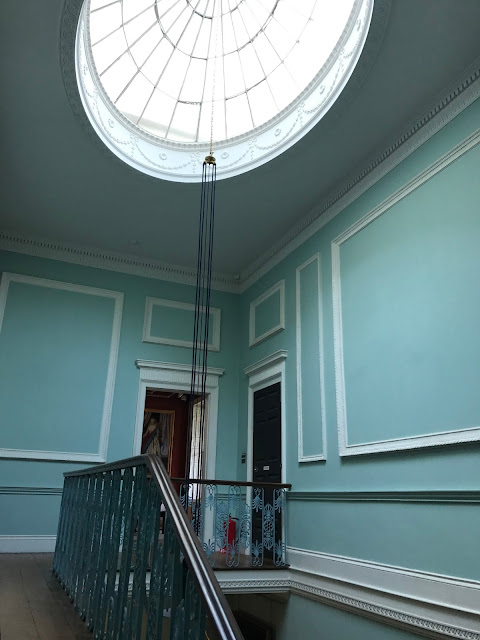
And what a job he did. Entering
the house, on a grey January Saturday, you are immediately struck by the warmth
and beauty of the place. I couldn’t believe it wasn’t packed – get on it people,
you’re missing out! Each room is hung with beautiful, silk wallpaper and a
recent rehang two years ago has seen the collection organised by nationality. The
result is a seamless, flowing experience, with every room feeling like a
beautiful capsule of the best of its time. My favourite rooms were the pastel-coloured
chambers dedicated to Rococo Watteaus and frilly Fragonards (including one picture which
Frozen fans might recognise…) as well as the ones with walls covered
with daft De Greuze paintings of
sad children holding animals. But the newly-refurbished
Great Gallery is a joy as well. Flooded with natural light, the new ceiling has
been returned to how it was during Wallace’s time in the 1870s, and does true
justice to the Collection’s most famous pieces – such as Frans Hals’s famous
Laughing Cavalier.


Anyway – enough about the art,
more about the clothes! Well, a 50s-style swing dress may not be
era-appropriate, but sure did match nicely with the wallpaper. And the pink
velvet shoes went perfectly with the Wes Anderson-esque restaurant, originally
named the Café Bagatelle after
Wallace’s final home in Paris and where
we enjoyed a superior lunch post-wander.
Apologies for the length of post,
I really could ramble for hours about this lovely place – and therein lies its
charm. The building itself is as lovely as the art displayed within it, it’s
right in the centre of London and – most excitingly of all – it is absolutely
FREE! Take a detour next time you’re on Oxford Street and experience an hour or
two of true beauty.
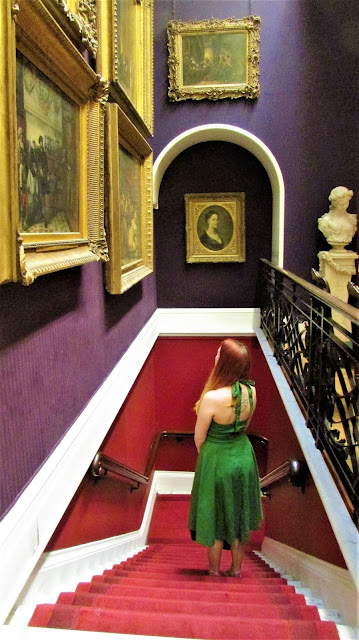 |
Dress - The "Myrtle" dress, Lindy Bop
Shoes - ASOS
Necklace - EcclecticEccentricity |
Opening times = Monday-Sunday, 10am-5pm
Admission = Totally free!
Closest Tube station = Bond Street